Structure of meaning
Everything needs a structure including
meaning. In this essay I'll try to explain how meaning is structured.
Meaning arises from the friction of struggle that happens because of the relationship between the subject with itself and the feedback loop between the objective and subjective, that gives rise to the understanding of the subject regarding life. The end goal is finding lifeness.
The feedback loop between the subjective and objective.
The relationship between the subjective and objective is one of complementarity not of contradiction, one inherently needs the other in order to exist, in order to have a point of reference.
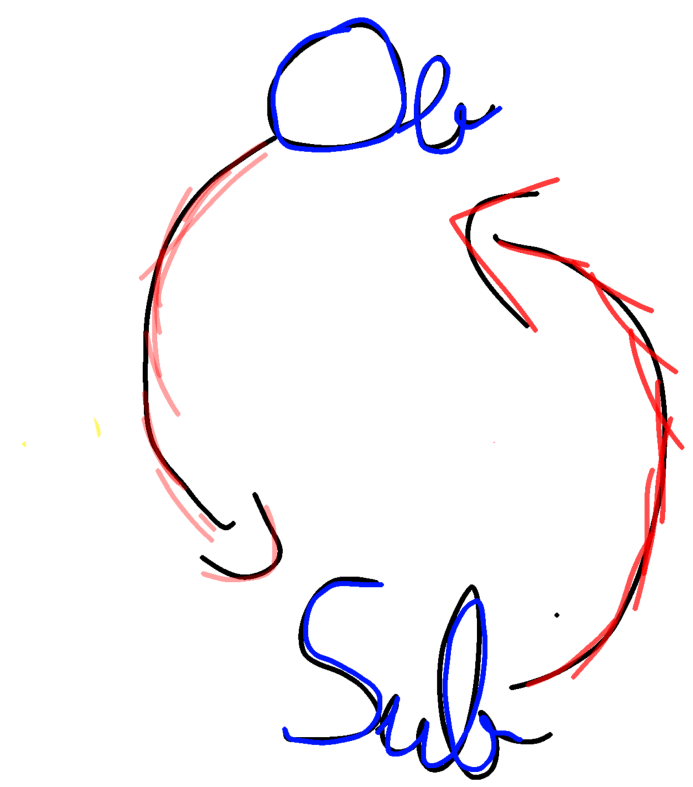
Ob stands for objective and sub for subjective, the arrows represent the relationship.
Without the subjective you wouldn't know what is the objective, this applies both literally and figuratively, meaning without the objective you wouldn't know the subjective but without the subjective you wouldn't be able to perceive anything.
The world is inherently viewed from the subject's perspective, from one own's mind, this fact is both backed up by philosophy, biology and neuroscience.
In the Kantian perspective we as subjects will never know the thing in itself but I believe that this should also apply to itself also, therefore we MIGHT never know the thing in itself meaning the objective, but we can perceive it. This does not mean that the objective doesn't exist, rather that we might never know its truest form.
Biology tells us that our eyes cannot perceive the full spectrum of colours, meaning an apple might as well not be red, could be purple or a colour we do not even know exist.
According to neuroscience, we do not see reality as it happens, we do not exactly live in the present but in the past by a few milliseconds, the time it takes for our brains to process the outside input but we also rather hallucinate reality, our brains filling in the details we are not able to pick up.
Our physical bodies influence our perception of reality greatly to the point that some drugs can distort our perception of it.
Is this not enough proof that we perceive the reality as subjects? That we can only perceive the objective throughout a subjective lens?
I'm not arguing against reason, I'm just saying that the objective cannot be rawly perceived I'm also not saying that we should fall into nihilism of the will, that we should not try to reach the objective but also I'm skeptical that one person's reason can be trusted, including mine , therefore we need as many rational thinkers as possible so that one day we MIGHT be able to reach the thing in itself as closely as possible.
The objective and subjective are complementary therefore they can overlap, when they overlay we discover truth but also it can create a feedback loop.
A feedback loop is a process in which the output of a system is fed back into the system as input, influencing how the system continues to behave.
The objective is fed into the subjective and throughout the subjective's lens it would be determined if it's true or not by feeding the subjects interpretation back into the system, to the objective, that throughout analysis and empirical data(if it exists) it would be determined if it is objective or not throughout the subject.
This process is constantly happening, even as you are reading this. It's a loop
Objective reality
Something exists or happens independently of you (events, facts, social structures, physical conditions).
Subjective interpretation
You perceive, interpret, and feel that objective reality (beliefs, emotions, meanings, values).Subjective response
Your interpretation guides your choices, actions, and attitudes.Objective consequences
Those actions alter the objective world (new facts, changed situations, outcomes).Return to subjectivity
The objective and subjective are equal in necessity but not always in intensity, one overpowers the other creating friction that gives rise to struggle. For example:
Objective: You fail an exam.
Subjective: You interpret it as proof you are inadequate.
Response: You withdraw or stop studying.
Objective result: Further poor performance.
Subjective update: The belief deepens.
Or, alternatively:
Subjective interpretation: You see failure as information.
Response: You adjust strategy.
Objective result: Improvement.
Subjective update: Confidence grows.
I'll let you decide which one has dominated where but what's clear is that it created friction said friction leads to struggle and said struggle leads to an end be it positive or negative.
There is also empirical proof of that right this moment, you're struggling/putting effort into trying to understand what I'm saying, throughout be it consciously or unconsciously the feedback loop.
Also, there's only a conceptual binary of objective and subjective when in reality it's a spectrum. If objective truths exist this means that subjective truths also exist. For example let's say:
A 6 or 9 is drawn unto the ground and two people are viewing from different perspectives, one will say it's a 6 the other a 9, both are right none is lying, this is a subjective truth.
While the objective truth here is that on the ground there is a number that can be both a 6 or 9, denying that is arbitrary, only the one who drew the number truly knows it.
But now taking this a metaphor of meaning, the meaning... true meaning of life can only be known by it's creator, be it God if you believe in him or the totality of the universe if you don't.
From here we can conclude both objective and subjective truths exist but this also means there exist lies.
A false doctrine arises when it presents itself as the total objective presented by a subject or the total subjective in a world with objective raw data, the fullest intensity of both only exists in the realm of concepts for us humans.
The relationship between the subject and the loop
From the relationship between the subject, itself and the complementary loop of the subjective and objective that creates friction and that leads to the friction creating the struggle between them arrises meaning, or rather the whole process is meaning itself.
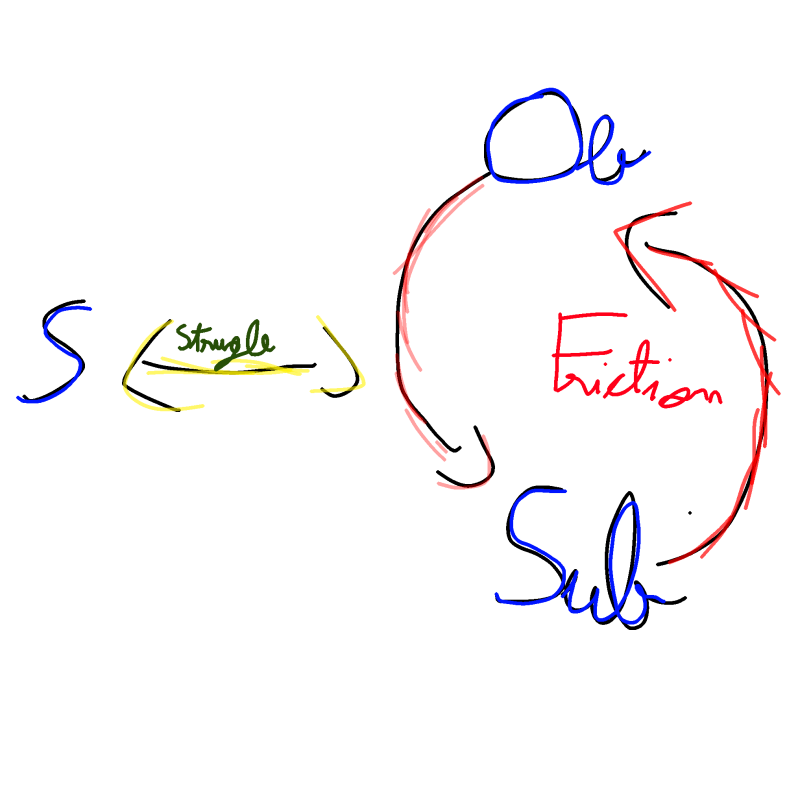
S stands for subject, the yellow arrow represents the relationship between the subject and the loop that causes friction and that is struggle, Sub stands for subjective and Ob stands for objective.
Friction is the struggle between the subjective and objective with the sense of effort between them not conflict.
Struggle in this system means effort, that can be both positive or negative but not a contradiction.
The scope of the effort, the struggle in this system derives from association, the association and the possible conflict between the subject with the loop of the objective and subjective.
Positive effort/struggle leads to association, complementary, symbiosis while negative leads to conflict or even contradiction. The process of the system is not contradictory but the output of it may be, if not truths and lies would be devoid of any meaning.
One might think because in my system the objective and subjective are of complementary nature this means contradictions or conflicts cannot arrise, meaning lies are devoid of meaning, they're social constructs the same as truths but one couldn't be more wrong.
The process itself cannot be contradictory or arbitrary but the output of it can be, because the subjective always holds more power in the struggle than the objective.(Beaucuse the subjective is the primary tool of perciving)
That's exactly because the subject relates itself to the system in order to perceive everything, the external reality can only be comprehended by the mind and from here arrises struggle.
The friction between the objective and subjective happens because of that, it's also the reason why the process of the subject relating itself to the system is a struggle.(struggle here also means the posibility of conflict but not conflict itself, keep that in mind)
Kierkegaard and the self.
The biggest inspiration I've had for this besides Kant, is Kierkegaard's perspective on the self.
While I do not fully agree with the theories of Kierkegaard I can't deny the fact that he is the predecesor of psychoanalytic thought, I'm quite sure that without a Kierkegaard we wouldn't have a Freud.
For Kierkegaard the self is a process of relation between itself and the dialectical relation between the finite and infinite, or to make this simpler to understand, the ideal and material, the opposites.
An oversimplification of dialectics is thesis, antithesis, synthesis. When two opposites, two contradictions form one thing for example: beeing(thesis),not beeing(anti thesis), becoming (synthesis). The synthesis is saw as the outcome between the fight or rather struggle between the thesis and anti thesis but the synthesis is always viewed as superior in comparison.
In Kierkegaard's perspective the process, the dialectical relation if related to the subject creates the self.
In this manner the self is not a finite outcome, it's not the synthesis but it is a relation of relations, a canvas that continues to be painted upon until it breaks.
Or in the philosopher's words “The self is a relation which relates itself to its own self, or it is that in the relation which is its relating itself to its own self; the self is not the relation but the relation’s relating itself to its own self.”
— Søren Kierkegaard, The Sickness Unto Death
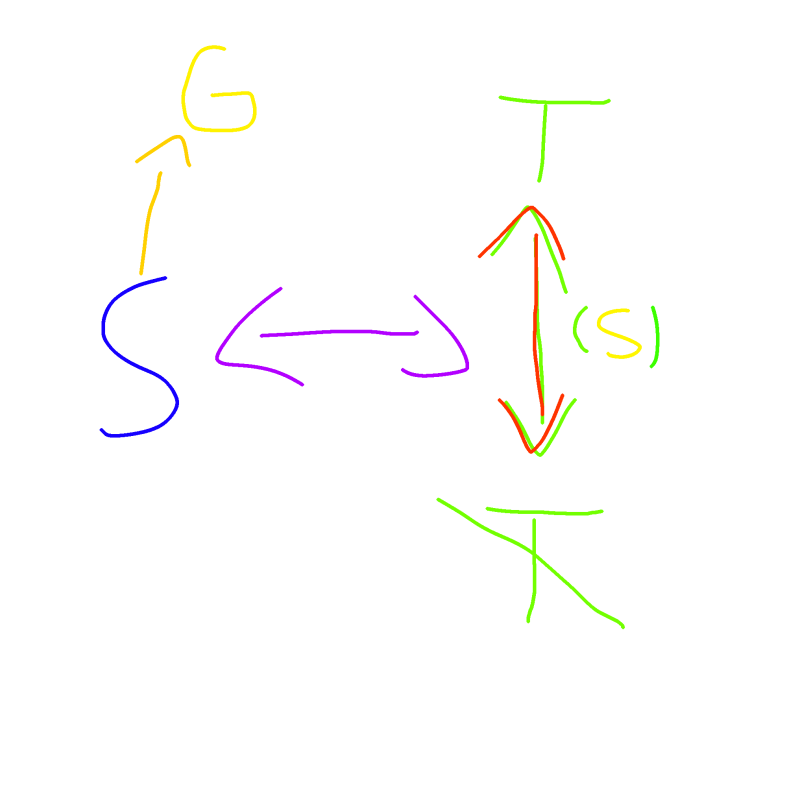
Blue S stands for subject, it points to G(God) because it brings it into the relation. Purple arrow is the relation between the relation (red arrow).
T stands for thesis, Slashed T stands for anti-thesis, red arrow is the dialectical relation that contains to an extent yellow S(synthesis).
Where I disagree with Kierkegaard is that he is an anti-systemic typa man, anti-structure to an extent , while what he provided is a structure in itself, a open ended one but a structure for sure and I also disagree with him on the matter of dialectics. If a synthesis can happen between the thesis and anti-thesis this means they're not contradictory but complementary as a process.
I also disagree with him on one element in the system, in all of that equation of his, there is an silent factor, you bring the demiurge into this system and I cannot understand why.
Making a connection with psychoanalysis, replace God with The mother and you get Freud in great lines. For me we do not need to bring any foreign element here, the subject contains it all, including his biases, environment, beliefs, religion or mother, the subject encapsulates it all.
While I agree with Kierkegaard that the self is a process of relations, a canvas that is painted layer upon layer until it vanishes, I disagree with him that it is dialectic or anti-structural, I think both the self arrises from this system, my system heavily inspired by his but also alongside it meaning.
Meaning shares the properties of the self, a relation of relations, a process not an end , an canvas painted layer upon layer shaped by it's artist, the subject.
The Subject being the totality of factors that comprises the individual, including the environment.
The end goal of this system is to produce meaning, a meaning that is entirely of the subject for the subject throughout the outside raw data objective world. In simpler terms throughout this system the subject perceives the world in its totality.
But what is the end goal of meaning? The end point of meaning is lifeness. So meaning has lifeness therefore it is absurd to say that life has meaning because it is the other way around, meaning contains life this is why if you live a life devoid of meaning by being too ignorant or arrogant to notice all the meaning around you, created by this structure, you live a lifeless life.
And also, life or lifeness points to death, so make your time count.
Conclusions
Both the self and meaning are a relation of relations, arising from the struggle between the subject relating to the complementary relationship between the objective and subjective (the loop), in which the subjective has more intensity than the objective because the mind perceives the outside world. The complementary part arises from the fact that the outside world shapes and determines the mind. The totality of outside and inside factors is the subject.
Both the self and meaning are a process of relations not an end product therefore it is pointless to find the one universal/true/authentic self or the ultimate meaning. They do not exist because they are under production and if the production will ever be done, only a Demiurge would know the true self or ultimate meaning, because he created it.
But this does not mean there's a lack of meaning or lack of self, rather there is too much and the effect is like a paralysed rabbit because of the mountain of carrots in front of him. There are many selves, there are many meanings, the world is full of them, one needs to be either too ignorant or arrogant to deny it.
Proof for the mountain of meanings can be found in language alone, every word is a shell carrying meaning, the shell can even have multiple meanings for example, like can both mean "the same" or "in favour" or even "love" -"Should I do it like this?" -"I like this food" -"I like my classmate".
The self can be also perceived as a shell of meaning and therefore meaning.
In conclusion the structure leads to meaning, meaning is the self, it's pointless to search for the ultimate meaning or self because only the ultimate creator truly knows the thing in itself,there are too many meanings for us humans to find the ultimate one, what you desire is not the ultimate self or meaning but lifeness, and lifeness can only be found in struggle and struggle can only be found in the process.
I hope you have enjoyed this, this material is as raw as possible and I wrotte it in the span of a two weeks of which I used my brain only in 3 days. The haotic writing is thanks to that but this also manifests estetically beacuse why not?